Websites
The Best Tattoo Artist Websites: Examples That Actually Get Bookings
Examples and templates of high-converting tattoo artist websites with portfolio organization, mobile design, booking tools, and local SEO tips.

The Best Tattoo Artist Websites: Examples That Actually Get Bookings
Most tattoo artists don’t need a flashy website. They need a website that does its job: show the work, answer the obvious questions, and make it easy to book.
The problem is most tattoo sites fail at one or more of those three things. The portfolio is buried. The booking process requires a DM. The site looks like it was last updated in 2017 and breaks on mobile.
The good ones get it right. They load fast, look sharp on a phone, and give a potential client exactly what they need to commit. This post covers 8 real examples, grouped by what they do particularly well, along with the patterns they all share.
What Makes a Tattoo Website Actually Work
Before the examples, a quick framework. The best tattoo sites consistently do a few things:
They lead with the work. Large, clean portfolio images above the fold. Not a logo. Not a tagline. The art.
They answer questions before they’re asked. Style specialties, deposit policies, wait times, what to expect. The more answered upfront, the less friction before a booking.
They make booking obvious. The button is visible, the path is short, and it works on a phone.
They build trust without a wall of text. Artist bios, studio photos, and client reviews do more than paragraphs of copy.
That’s the checklist. Here’s who does it best.
The Examples
Portfolio-Focused: Work Front and Center
These sites prioritize one thing above all else: showing the art clearly.
Jessi Cramer Tattoo Artist
jcramertattoos.com | Pittsburgh, PA
Jessi Cramer’s site is a good model for solo artists. The homepage leads with her specialty (fine line illustrative blackwork) and immediately organizes her portfolio into clear categories: antique tattoos, custom work, flash, and drawn-on designs. That structure means a potential client knows within 10 seconds whether her style matches what they want.
The first-person voice throughout the site creates a genuine sense of who she is and how she works, which matters for a private studio where the relationship is part of the experience. The booking link is visible at every scroll depth.

Art Ink Tattoo Studio
artinktattoostudio.com | New York City (Times Square)

Art Ink packs a lot of information into a clean layout: six resident artists, each with a bio and photo, a clear list of style specialties (realism, old school, new school, watercolor, abstract), and online booking. The effect is a site that functions like a portfolio for the whole studio rather than a generic “book now” page.
The detail matters here. A client looking for a specific style can identify which artist fits their vision before reaching out. That reduces back-and-forth and brings in clients who are already committed.
Booking-Optimized: Designed to Convert
These sites make the path from visitor to booked appointment as short as possible.
Black Tower Tattoo Studio
blacktowertattoo.com | Los Angeles, CA
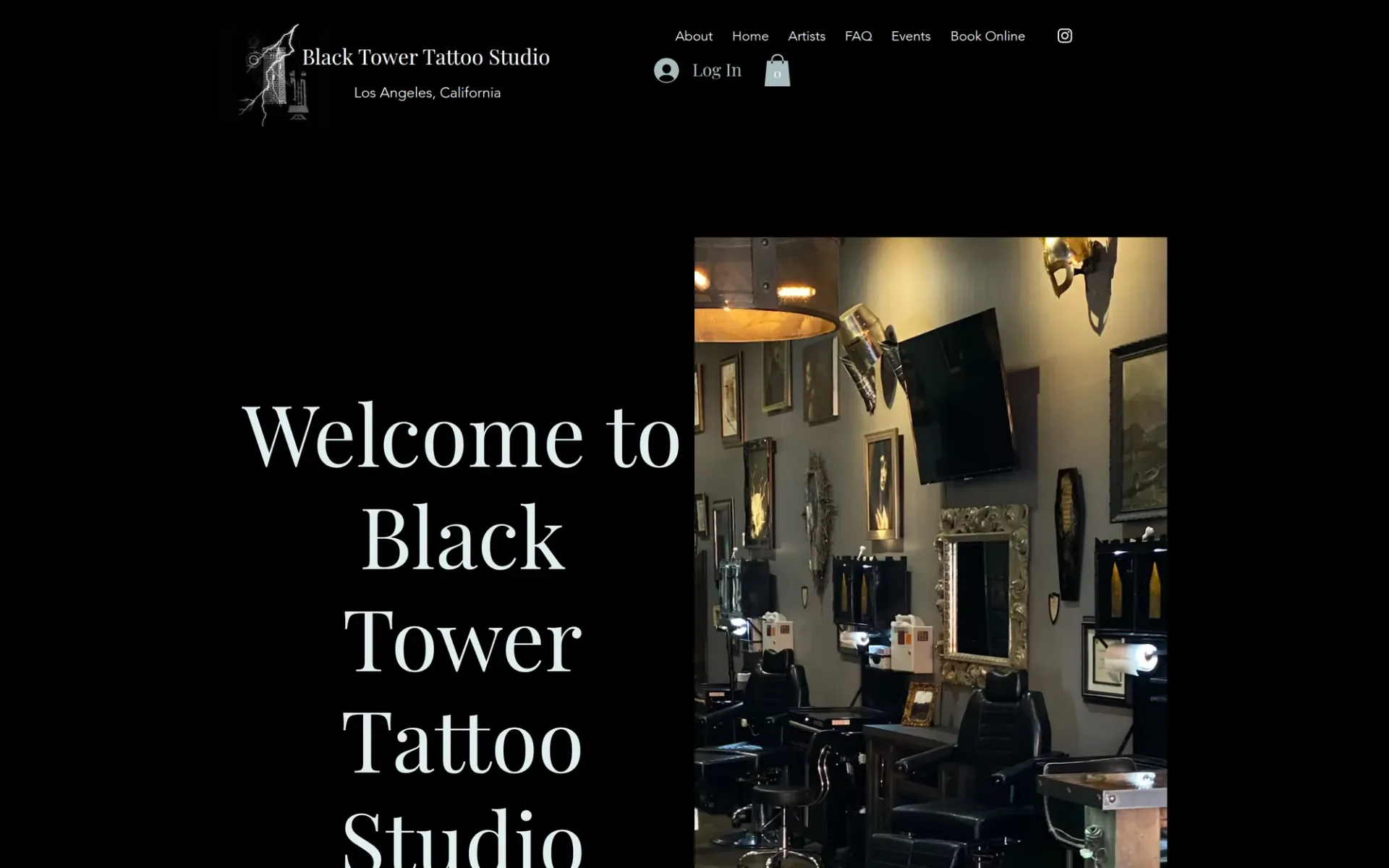
Black Tower leads with a video tour of the studio on the homepage. That’s an unusual choice, but it works: you immediately get a feel for the environment, the aesthetic (“Clean. Bold. Professional.”), and the team. By the time you reach the booking link, the trust is already there.
The site also includes a full FAQ section that handles the common hesitations before they become objections. Artist bios are specific, and the events section gives the studio a sense of an active, engaged community. The booking button is in the top navigation on every page.
Geek Ink Tattoo
geekinktattoo.com | Broken Arrow, OK

Geek Ink leads with a clear value statement and an immediate CTA: “Book a Consult.” Not “book an appointment” in a system where you don’t know who you’re getting. A consultation. That framing sets expectations and gives indecisive clients an easy first step.
The artist bios are strong, each with a name, photo, and specialty clearly laid out. The site also includes a blog, which helps with local search visibility over time. The pop-up chat feature answers questions without requiring any commitment, which lowers the barrier for first-time clients.
Brand-Forward: Identity That Attracts the Right Clients
These sites have a clear point of view that draws in a specific type of client and filters out mismatches.
Atelier Eva
ateliereva.com | Williamsburg, Brooklyn (two locations)

Atelier Eva positions itself as a “spa-like experience” for fine line tattoos, and the website reflects that consistently. Clean white space, refined typography, and an absence of the dark/edgy aesthetic common in tattoo sites. Founded by fine art tattooer Eva Karabudak, the studio specializes in fine line, black and grey, realism, botanical, and abstract styles.
The site uses video content well, showing the studio environment and the process rather than just static portfolio images. Client reviews are embedded directly on the homepage. For artists who want to attract a high-end, style-conscious clientele, this site shows how visual positioning translates directly into the right bookings.
Generation8Tattoo
generation8tattoo.com | Hermosa Beach, CA

Generation8Tattoo leads with the founder, Dave, and tells his story: born and raised in Hermosa Beach, started tattooing young, built a studio rooted in that history. The effect is a site that feels personal rather than corporate. Clients who book here know they’re getting a specific artist with a specific background.
The shop also covers body piercing services with the same level of detail as tattooing, which is useful for studios offering both. The site’s personality is strong enough that it self-selects clients who fit the vibe.
Clean Design and Mobile Experience
These sites are worth studying for how they look and function on a phone, where the majority of tattoo clients are browsing.
NYC Tattoo Shop
nyctattooshop.com | Brooklyn, NY

NYC Tattoo Shop opens with a strong sense of place: the site roots itself in the history of tattooing in New York, from the first electric tattoo machine in the 1890s to today. That context builds credibility before a client even sees the portfolio.
The navigation is straightforward, the images are large and clear, and each artist has a bio with enough personality to help clients choose. Booking is accessible from the homepage with a short scroll. The site is built on WordPress, which means it’s regularly updated and performs well for local search.
Lass Tattoo
lasstattoo.com

Lass Tattoo is built on Webflow and shows what a clean, minimal design can do for a tattoo site. The aesthetic is tranquil rather than edgy, which serves the studio’s positioning well. The navigation is simple, the images are given room to breathe, and the booking path is direct.
The “you-first” framing throughout the site (focused on the client’s experience rather than just studio credentials) is a good model for artists who want to attract clients who are new to tattooing or looking for a less intimidating environment.
Common Patterns Across the Best Sites
Looking at all eight examples, a few things stand out.
The portfolio is never buried. On every site above, you can see the work without clicking more than once. That’s deliberate. Clients are visually screening you before they read a word.
Artist bios are specific. The best ones include style specialties, a photo, and some personality. Generic bios (“passionate about tattoo art”) don’t build trust. Specific ones do.
Mobile experience isn’t an afterthought. Most of these sites were clearly designed with a phone in mind first. Short load times, large tap targets, visible booking links.
Local SEO is supported. City name in the title tag, Google Business Profile linked or embedded, location information easy to find. When someone searches “tattoo artist [city],” these sites have what they need to show up.
Booking is never more than two clicks away. The path from landing on the site to getting to a booking form is short and obvious. No buried contact pages, no confusing navigation.
Reviews appear early. Social proof is visible without scrolling to the bottom of the page.
How to Get There
Building a site that checks all these boxes is more straightforward than it sounds. The technical part isn’t what slows most artists down. It’s the setup time, the choices about design direction, and figuring out how to connect a booking system to a website.
For artists who want a portfolio up fast, the free Portfolio Template at Tattoo Studio Pro gets you a single-page site with your bio, gallery, and contact form. No code, no monthly fee.
If you want more than one page and you’re comfortable editing HTML, the free tattoo website template is a full multi-page build you download and keep. No signup, no email wall, no monthly fee. Host it anywhere.
For a full multi-page site with better SEO structure, the tattoo artist website template is a 6-page build with a home, about, portfolio, services, contact, and aftercare page. Hosting runs $10/month after a free trial period, and you own every file. If you cancel, the site doesn’t disappear. Studios with several artists to show off want the studio website template instead, which gives every artist their own page.
There’s also a done-for-you setup option if you’d rather send over your content and have someone handle the setup, branding, and launch, or a fully custom tattoo shop website if a template isn’t the right fit.
The goal in any case is the same as the sites above: show the work, answer the questions, make it easy to book.
If you’re also thinking about SEO for your site, this guide covers the basics of tattoo website SEO including what to include on each page and how to rank for local searches.
For a longer look at the pros and cons of generic website builders for tattoo artists, see why Squarespace costs more than it looks. And if you’re weighing templates against a fully designed site, our guide on custom tattoo shop websites breaks down when it makes sense to go beyond a template.
FAQs
What should a tattoo artist website include?
At minimum: a portfolio with clear, well-lit photos organized by style, artist bios with specialties listed, booking information (or a direct booking link), location and contact details, and some indication of your deposit and cancellation policies. The more questions you answer upfront, the fewer DMs you’ll field.
How much does a tattoo artist website cost?
It depends on how much you build versus how much you hand off. A basic portfolio site can be free if you use a tool like Tattoo Studio Pro’s free Portfolio Template. A full multi-page site typically runs $99 to a few hundred dollars for a template, plus hosting ($10 to $30/month depending on the platform). Custom-designed sites from agencies start around $2,000-$3,000.
Does a tattoo artist really need a website if they have Instagram?
Yes. Instagram doesn’t show up in Google search results when someone types “tattoo artist near me.” A website does. Around 97% of people research a business online before booking. If you’re not on Google, you’re invisible to that search intent.
What’s the best website builder for tattoo artists?
There’s no single answer, but purpose-built options (like the Tattoo Studio Pro website templates) tend to require less setup than generic builders because they’re designed with tattoo workflows in mind. Generic builders like Squarespace or Wix work fine for design, but require more time to configure booking, portfolio, and local SEO from scratch.
How important is mobile design for a tattoo website?
Very. The majority of people searching for tattoo artists are on their phones. If your site is slow, hard to navigate on mobile, or hides the booking button, you’ll lose clients before they ever reach out. Test your site on your own phone regularly.
See more website resources for tattoo artists at tattoostudiopro.com/websites/for-tattoo-artists/. Also check out the complete guide to tattoo portfolio websites for a breakdown of your options.