Websites & Portfolios
How to Rank for "Tattoo Artist Near Me" (The Style-First Approach)
Most tattoo studios chase the same generic 'tattoo artist near me' keyword and wonder why they're stuck on page two. The studios that actually rank and stay ranked target style-specific searches first. Here's exactly how.
Most tattoo studios chasing “tattoo artist near me” are fighting the wrong battle. That head term pits every shop in your city against each other for three map pack spots. The studios holding those spots have months or years of review velocity and citation authority behind them. You can’t close that gap in a few weeks.
What you can do: build style-specific pages that barely any competitor has optimized, rank for those within weeks in most markets, and let that traffic build the review momentum that eventually lifts your head-term ranking too. A person searching “blackwork tattoo artist near me” already knows what they want. They’re not browsing. They’re ready to book.
Style-first keyword strategy, the booking conversion layer, and E-E-A-T trust signals are the three things no competing SEO article for tattoo studios handles properly. Each one is covered below.
Why Style-Specific Keywords Beat the Head Term
“Tattoo artist near me” is the keyword everyone wants. It’s also where every studio in your city is stacking up. The three map pack spots in a competitive market go to businesses with consistent local SEO work behind them.
Style-specific long-tails are a different situation. Search volumes are lower, but the person typing is further along in the decision. They’ve already chosen a style. They’re not comparing six studios. They’re looking for the one that proves it specializes.
| Generic term | Style-specific alternative | Why it converts better |
|---|---|---|
| tattoo artist near me | blackwork tattoo artist near me | Filters to studios that specialize |
| tattoo shop near me | realism tattoo artist near me | High-commitment style = serious buyer |
| tattoo studio near me | watercolor tattoo artist [city] | City modifier reduces competition |
| best tattoo artist | fine line tattoo near me | Trend-driven demand, few shops optimize |
| tattoo near me | traditional tattoo near me | Quality-seeking intent, not price shoppers |
A studio that builds a dedicated page for “fine line tattoo artist Portland” is frequently the only one optimizing for that term. A page specifically about your fine line work, with portfolio examples, artist bio, and a direct booking link, will outrank generic studio pages for that search within 4 to 10 weeks in most mid-size markets.
How to build style pages that actually rank:
- Create a separate page for each style you offer, not just a gallery tab or portfolio category.
- URL structure:
yoursite.com/fine-line-tattoo-austin/(style plus city, hyphens not spaces). - On-page H1: “Fine Line Tattoo Artist in Austin, TX.” Keyword-first, specific, matches what people type.
- Body content: minimum 400 words covering the style, your approach to it, what clients should expect during healing, design consultation process, and pricing range. A real page, not a glorified caption.
- Portfolio: 8 to 12 healed examples of that specific style only, with descriptive alt text including style and location.
- CTA: Direct booking link or deposit form visible without scrolling.
Only build style pages for styles where you have real portfolio volume. A page for “blackwork tattoo artist Seattle” with 3 photos and 100 words helps no one. Build your top 2 to 4 specializations properly first, then expand as your portfolio in other styles grows.
Avoid thin location variations. A page that swaps “Austin” for “Round Rock” and changes nothing else is a doorway page. Google ignores or penalizes these. Each style page needs genuine content about that style, not keyword-stuffed filler.
For the broader local SEO picture beyond your website, local SEO for tattoo shops covers the full signal stack.
What a style page is actually worth
The math is worth running before you build. Take a mid-size market where “blackwork tattoo artist [city]” gets 150 monthly searches. A page ranking in position 1 captures roughly 28% of clicks, around 42 visitors per month. If 8% of those visitors request a consultation, that’s 3 to 4 consultations. At a 60% conversion from consultation to booked deposit, you’re adding 2 to 3 sessions per month from one style page.
A 3-hour blackwork session at $200/hour is $600. Two new sessions per month from one style page is $1,200 in monthly revenue you can trace directly to that page. Build four style pages for your core specializations and you have a number attached to each one.
This is why style pages pay off where head-term chasing doesn’t: you’re winning a defined space against few or no direct competitors, and the people clicking already know they want your style.
Google Business Profile: What Actually Moves Rankings
Every SEO guide tells you to claim your GBP and add photos. That’s table stakes. Here’s what the studios holding top map pack positions do that the advice-givers skip.
Category selection matters more than most studios realize
Google allows one primary category and several secondary categories. Most studios pick “Tattoo Shop” and stop. Top-ranking profiles also add secondary categories for adjacent services:
- “Body piercing shop” if you pierce
- “Art gallery” if you display work or sell prints
- Style-specific categories when Google makes them available
Primary category should always be “Tattoo Shop”, not “Tattoo Artist”. That label carries lower local pack authority. Secondary categories extend your visibility to adjacent searches without diluting your primary signal.
Photos that signal specialization
Generic exterior shots don’t drive rankings. The photo types that improve profile clicks and ranking signals:
- Healed work only. Fresh tattoos look raw and can undermine trust. Show healed results at 4 to 6 weeks.
- Style-specific groupings. If you specialize in blackwork, 80% of your GBP photos should be blackwork. Flood the profile with your best work in your primary style.
- Mid-session process shots. Show craft and professionalism, not just finished results.
- Individual artist portraits. Google increasingly surfaces artist-level profiles inside studio listings. One photo per artist minimum.
Upload 2 to 3 new photos per week. An active profile tells Google your business is current and client-facing. Studios that batch-upload 50 photos once and never touch the profile again lose ground to consistent competitors.
The Q&A section as a conversion tool
Google’s Q&A section lets anyone ask and answer questions about your business. Most studios ignore this, which means clients sometimes answer with inaccurate information, and your search result becomes a liability.
Preemptively seed your Q&A with the questions you actually get:
- “Do you take walk-ins?” (Answer honestly with days/times)
- “How far out are you booked?” (Give a real range: “currently 4 to 6 weeks for custom pieces”)
- “What styles does [Artist Name] specialize in?”
- “Do you require a deposit to book?”
These answers appear in the knowledge panel before someone even clicks through to your site. A studio that answers “walk-ins welcome Tuesday and Thursday, custom pieces book out 4 to 6 weeks” converts better than one with no Q&A, because the searcher’s main objections are resolved before they click.
For a detailed walkthrough of GBP optimization, see the Google My Business profile guide for tattoo artists.
On-Page Signals Google Actually Weighs
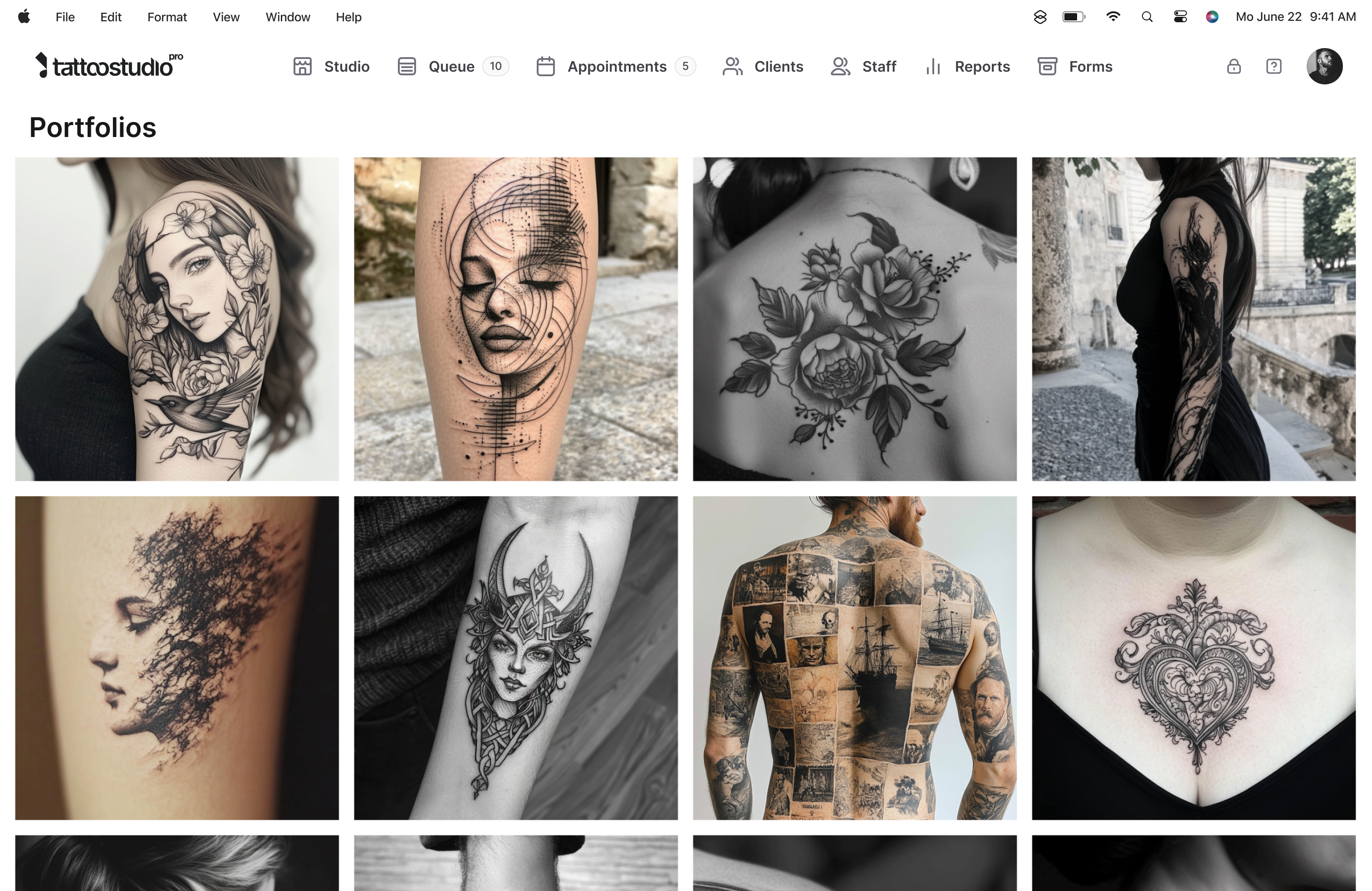
Organizing your portfolio by style in Tattoo Studio Pro feeds directly into the style-specific pages that rank.
NAP consistency: the silent ranking factor
Your Name, Address, and Phone number must be identical across every platform where your studio appears. Not similar. Identical. “St.” versus “Street” is a discrepancy. “Suite 4” versus “Ste. 4” is a discrepancy. Google treats inconsistent NAP as a trust signal failure and weights it when determining how much authority your local presence has.
What inconsistency looks like in practice: your GBP says “Anchor & Iron Tattoo, 423 SW Morrison St, Suite 4, Portland, OR 97204.” Your Yelp listing says “Anchor & Iron, 423 SW Morrison Street #4.” That’s three mismatches (name, street abbreviation, suite format) across two directories. Multiply by 15 directories and you have a citation footprint Google can’t fully reconcile. A studio with clean citations can rank above you despite having fewer reviews.
Document your canonical NAP format in a spreadsheet. The format you use on GBP is your master record. Match it everywhere, and update every listing immediately after any address or phone change.
Schema markup: helping Google parse your business
Schema markup tells Google exactly what kind of business you are, where you’re located, and what you offer. For tattoo studios, two types matter:
LocalBusiness schema defines your NAP, hours, price range, and service area. This powers the knowledge panel in search results: the box showing your hours, address, and contact info without anyone clicking.
AggregateRating schema surfaces your star rating directly in the SERP. A result showing 4.8 stars (67 reviews) next to a bare listing earns a higher click-through rate than an unrated result, per BrightLocal’s Local Consumer Review Survey. Rating visibility is the difference between being a name in a list and being the obvious choice.
If your website was built on a platform that handles technical SEO automatically, like Tattoo Studio Pro’s website templates, this schema is already implemented. You keep your profile information accurate; the schema reads from it.
Mobile load speed
Google’s mobile-first indexing documentation confirms that Google uses the mobile version of your site as the primary basis for ranking. Over 70% of “near me” searches happen on phones.
A portfolio-heavy site that loads in 4 seconds will rank below a faster competitor regardless of other SEO work. Target under 2 seconds for first contentful paint on mobile. Compress portfolio images to under 200KB each, use WebP format, and let your CDN handle delivery. If your hosting includes a built-in global CDN (standard on Tattoo Studio Pro’s website hosting, which runs across 275 cities), this happens automatically.
The Conversion Layer: After You Rank
This is the gap every competitor SEO guide ignores. You can rank in position one for “blackwork tattoo artist Denver” and still lose the booking if your landing page doesn’t answer what a high-intent visitor arrives expecting to find.
Consider two studios ranking for “Japanese tattoo artist near me.” A client ready to commission a full sleeve visits both sites. Studio A says “Pricing varies by design complexity.” Studio B says “Multi-session sleeves start at $1,200 for the outline session. Full-color completion typically runs $2,500 to $4,000 depending on coverage and detail. Free consultations available Tuesday through Friday.”
Studio B books the call. Not because they’re cheaper, but because they gave the client a number to plan around. A vague pricing answer doesn’t just leave the visitor unsatisfied. It sends them back to the search results, where the next result gives them a number. You ranked. You just didn’t convert.
The person who clicked wants to know four things:
- Is this actually the style I want? Show 8 to 12 healed examples of that specific style immediately, not a mixed portfolio.
- Can I afford it? List a real starting rate. “$300 minimum, most custom pieces run $400 to $900 depending on size and complexity” is useful. “Pricing varies” is not.
- How hard is it to book? One visible booking link or deposit form. If they have to dig through three pages to figure out how to make an appointment, many won’t bother.
- Is this artist legitimate? Bio with years of experience, training history, and certifications. Not “Sarah loves tattooing and has been creating art her whole life.” Instead: “Sarah has been tattooing professionally since 2013, trained under Marcus Chen at Iron Temple Collective in Chicago, and specializes in large-scale realism and portraiture.”
The tattoo artist website guide for getting bookings covers the full landing page structure. The short version: a high-intent near-me searcher who can’t find a price, booking method, and relevant portfolio within 10 seconds goes back to the results page.
Portfolio organization as a conversion signal
Your portfolio isn’t just showing work. It’s doing targeting. A realism client who lands on a page mixing blackwork, color traditional, and watercolor will wonder if you specialize in anything. They’re looking for proof you’ve done their style many times before.
Organize your tattoo portfolio examples by style, not by date or artist preference. A dedicated gallery for “Realism Tattoos” with 40 healed examples converts at a higher rate than a mixed portfolio with the same images scattered throughout. It signals expertise, not breadth.
If you’re deciding how to structure this work online, physical vs. digital tattoo portfolio explains why digital format has a clear advantage specifically for near-me capture: a client who finds you through search needs to book from wherever they are, not come in to flip through a binder.
E-E-A-T: The Google Trust Signals Most Studios Skip
E-E-A-T (Experience, Expertise, Authoritativeness, Trustworthiness) determines whether Google treats your site as a legitimate local business or a thin web presence. For tattoo studios, four concrete signals move this:
Artist bios with real credentials. A bio that reads “Marcus has been tattooing professionally since 2011, trained under Jason Rivera at Black Anvil Collective in Chicago, and specializes in large-scale realism and blackwork” outranks “Marcus is a talented artist passionate about his craft.” Specific years, named training studios or mentors, and stated specializations are E-E-A-T signals in prose form. Every artist on your team needs one.
Health and licensing page. A dedicated page covering your studio’s licensing status, most recent health inspection result, autoclave sterilization process, and blood-borne pathogen certifications signals legitimacy to both Google and potential clients. Link to your state’s official body art licensing requirements to demonstrate compliance. Almost no tattoo studio publishes this page. That’s exactly why it works as a trust signal.
Before-and-after documentation. Cover-up portfolios, scar work, and touch-up documentation show multi-session expertise and client trust. These aren’t just portfolio pieces. A gallery of 15 documented cover-up progressions says more about your skill than 15 standalone flash pieces. They demonstrate depth of practice that new studios literally cannot fake.
Review velocity and response rate. BrightLocal’s Local Consumer Review Survey consistently shows that response rate is a stronger trust signal than raw review count. Studios that respond to every review within 48 hours (including critical ones) outperform high-volume review collectors who never engage. Two new reviews per week for six months will outperform a sprint of 30 reviews that then stops cold. Google weights recency and steady cadence.
According to Google Search Central’s structured data documentation, businesses with complete, accurate local business schema and consistent review presence are substantially more likely to earn rich results in local search.
What Your Website Platform Handles Automatically
Several of the technical requirements above are handled without any action on your part if you’re running a site built on Tattoo Studio Pro’s templates:
- Schema markup: LocalBusiness and AggregateRating schema are built into the template and read from your profile data automatically.
- Mobile optimization: Responsive design and asset compression are default. No plugin required.
- CDN delivery: Images load from servers near your visitor. Tattoo Studio Pro’s hosting runs a 275-city global CDN, so load time stays fast regardless of where in the country a client searches from.
- Clean URLs:
/blackwork-tattoo-austin/rather than/page?id=1234&cat=tattoo. - Meta title and description fields: Exposed in the visual editor so you can set them per page without touching code.
Your remaining work: the content strategy (style pages, artist bios, portfolio organization), the local signals (GBP maintenance, NAP consistency, review cadence), and the conversion layer (pricing transparency, direct booking path). That’s a focused list.
For the broader question of platform ownership versus renting from a page-builder that controls your URL, see why owning your tattoo website matters.
Start a free 30-day trial of Tattoo Studio Pro to see exactly what the platform handles automatically and what it leaves in your hands.
FAQs
How long does it take to rank for “tattoo artist near me”?
For the head term in a competitive city, expect 6 to 12 months of consistent work before you hold a map pack position reliably. Style-specific terms move faster: a well-built page targeting “fine line tattoo artist [your city]” can rank within 4 to 10 weeks in most mid-size markets. The practical approach is to build style-specific pages first, use that traffic to build review velocity, and let the head term rankings follow from the momentum.
Do I need a Google Business Profile to rank in near-me searches?
Yes, for the map pack. The three results shown above organic listings are exclusively GBP results. A website-only strategy can get you into organic results below the map, but capturing map pack visibility requires a verified, optimized GBP. Without one, you’re competing for positions below studios that have one, which in mobile search means many searchers never scroll to you.
Should I create separate pages for every tattoo style I offer?
Only for styles where you have real portfolio volume and genuine work to show. A page for “blackwork tattoo artist Seattle” with 3 photos and 100 words helps no one. Build style pages for your top 2 to 4 specializations, do them properly (400-plus words, 8-plus healed portfolio examples, a real booking path), and expand from there as you build more work in other styles.
How many reviews do I need to appear in Google Maps results?
There’s no published threshold. Google weights review count, recency, and response rate together. In practice, studios with 40-plus reviews and an average above 4.5 stars tend to hold map pack positions in competitive markets. More importantly: review velocity matters more than a one-time push. Two genuine reviews per week for 6 months will outperform a sprint of 30 reviews that then stops cold.
Does social media activity help Google rankings?
Not directly. Social signals don’t influence Google’s local ranking algorithm. The indirect effect is real: Instagram reach drives branded searches, generates referral traffic, and occasionally earns backlinks when other accounts share your work. Don’t skip it, but don’t count it as a substitute for GBP work and on-page optimization.
What tattoo keywords should I target beyond “tattoo artist near me”?
Start with your top 2 to 3 styles plus your city: “blackwork tattoo artist [city],” “realism tattoo [city],” “fine line tattoo near me.” Then add neighborhood modifiers once you’re getting consistent traffic: “tattoo artist [neighborhood]” for high-density urban areas. Body part searches like “sleeve tattoo [city]” convert well for high-commitment clients. Avoid “cheap tattoo near me”. It attracts price shoppers, generates difficult client relationships, and tends to produce lower-quality reviews.
What if my NAP is inconsistent across multiple directories?
Fix it before doing anything else. Start with GBP, Yelp, Facebook, and Apple Maps. Use the exact same format everywhere: if your Google listing says “123 Main St, Suite 4,” every other listing needs “123 Main St, Suite 4,” not “Suite #4” or “Ste. 4.” The format on GBP is your master record. Update every directory immediately after any address or phone number change.
How do I optimize my tattoo portfolio for Google image search?
Use healed work shot in clean lighting against a neutral background, photographed at 4 to 6 weeks post-heal when color has settled and skin looks clean. File names should be descriptive: blackwork-dragon-sleeve-portland.webp rather than IMG_4847.jpg. Alt text should include style, subject, and city: “blackwork dragon sleeve tattoo, Portland Oregon.” These image signals reinforce the same style-plus-location theme your style pages target, and healed photos convert better than fresh work when a new client is deciding whether to book.